
Norwood Scale Explained: Hair Loss Stages and How Many Grafts You Need
If you have ever stood under a bathroom light trying to work out how much your hairline has moved, you already understand why doctors use a scale. Hair loss happens slowly, and it is hard to judge on your own. The Norwood scale gives you and your doctor a shared language for where you are today and where things may be heading.
Book Free Consultation
This guide explains each of the seven Norwood stages in plain terms, what treatment usually makes sense at each one and how many hair transplant grafts are typically needed. By the end, you should have a fair idea of your own stage before you walk into a consultation. Once you know your stage, our Bhubaneswar hair transplant page explains which technique fits and what treatment involves.
What Is the Norwood Scale?
The Norwood scale, sometimes called the Hamilton-Norwood scale, is a classification system for male pattern hair loss. It was first described by Dr James Hamilton in the 1950s and later updated by Dr O'Tar Norwood in the 1970s. It is still the most widely used tool in hair restoration today.
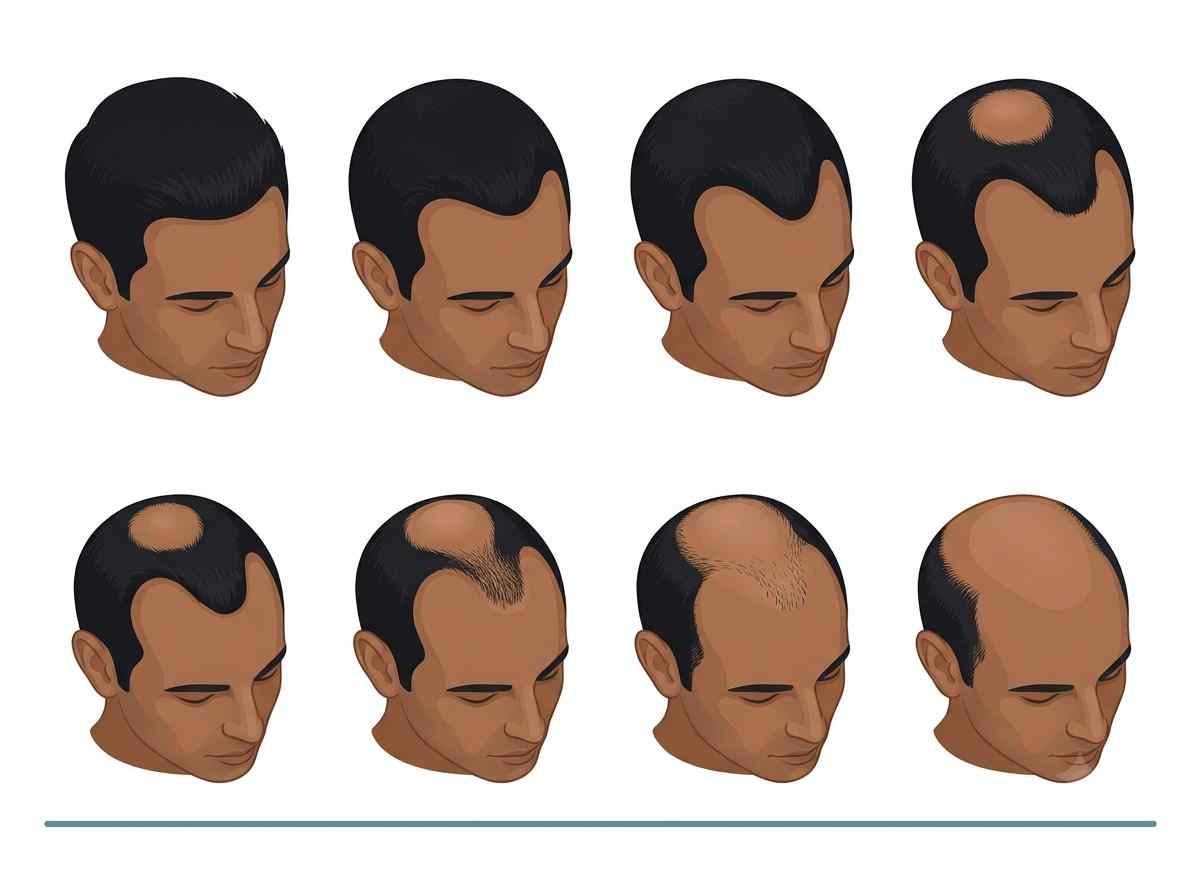
The scale has seven main stages. Stage 1 shows little or no hair loss, and stage 7 shows the most advanced pattern, with only a band of hair left around the back and sides. Some stages also have an A variant, where loss moves from front to back without a separate bald spot on the crown.
The 7 Stages of the Norwood Scale
Stage 1: No Significant Loss
The hairline sits in its adult position with little or no recession. Most men at this stage do not need any treatment. If you have a strong family history of baldness, this is a good time to start paying attention.
Stage 2: Slight Recession
The temples begin to move back slightly, often forming a mild M shape. This is very common in men in their twenties and is often simply the change from a teenage hairline to an adult one. A transplant is rarely needed here.
Stage 3: First Visible Baldness
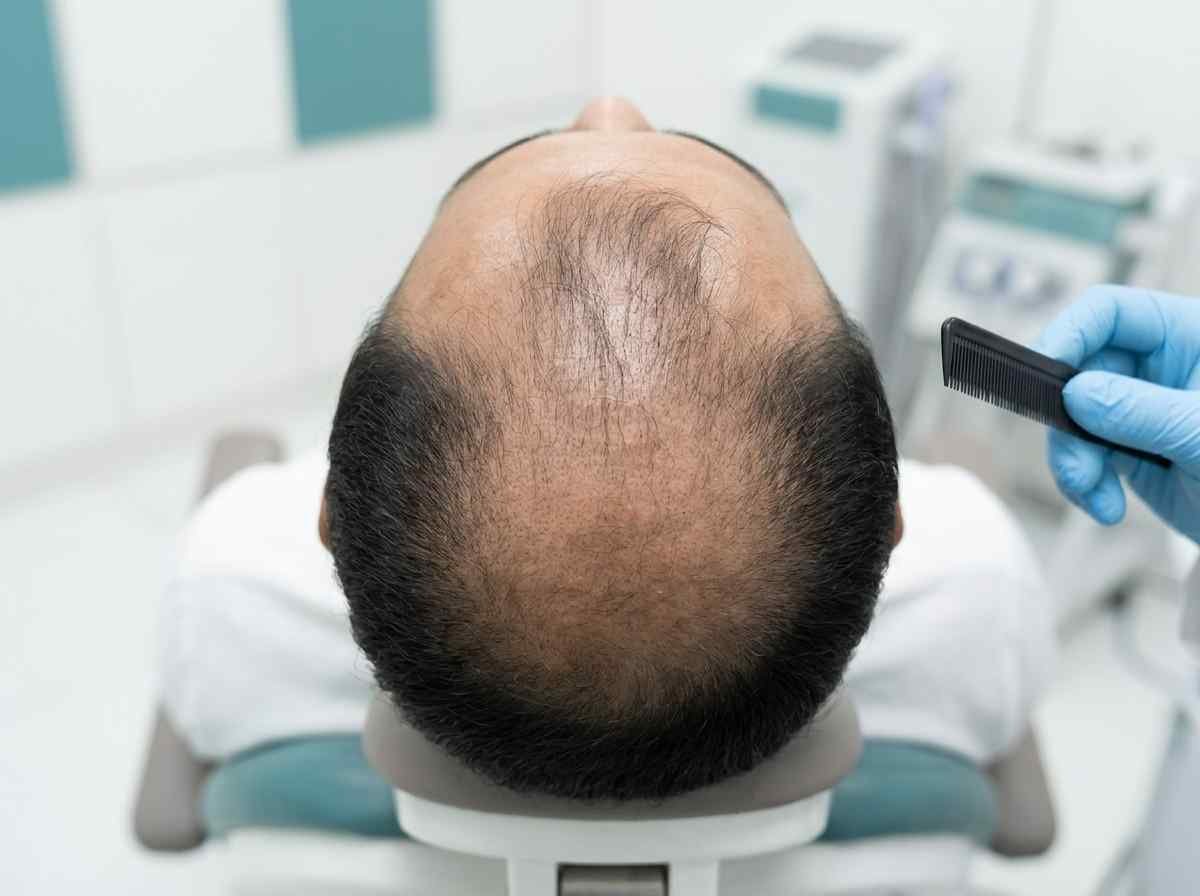
Stage 3 is usually where hair loss becomes clinically meaningful. The temples recede deeply, and the hairline may look thin from the front. A variation called stage 3 vertex adds thinning at the crown. This is the stage where many men first consider a hair transplant.
Stage 4: Front and Crown Both Affected
Hair loss at the front deepens and a clear bald spot forms on the crown. A band of hair still separates the two areas.
Stage 5: The Bridge Starts to Thin
The band between the front and crown becomes thin, and the two bald areas start to join. More grafts are needed, and planning becomes more careful.
Stage 6: The Bridge Is Gone
The front and crown have merged into one large bald area. Hair remains at the sides and back. A transplant is still possible for many men, but the focus shifts to creating a natural frame for the face rather than full coverage.
Stage 7: The Most Advanced Pattern
Only a narrow horseshoe of hair remains around the sides and back. The donor area itself may be thinner. Results depend heavily on donor quality, and two sessions may be needed.
How Many Grafts Do You Need at Each Stage?
The table below gives typical graft ranges at each Norwood stage. These figures are a starting point. Your actual number is decided after your doctor examines your scalp, checks your donor density and agrees the goals with you.
| Norwood Stage | What It Looks Like | Typical Graft Range | Usual Approach |
|---|---|---|---|
| Stage 1 | Adult hairline, no real loss | Not needed | Monitor, healthy hair care |
| Stage 2 | Slight temple recession | 500 to 1,000 | Usually medical treatment first |
| Stage 3 | Deep temple recession | 1,000 to 2,000 | Hairline restoration |
| Stage 3 Vertex | Recession plus crown thinning | 1,500 to 2,500 | Hairline plus crown support |
| Stage 4 | Front and crown loss, band remains | 2,000 to 3,000 | Front first, crown as donor allows |
| Stage 5 | Bridge thinning | 3,000 to 4,000 | Larger session, careful planning |
| Stage 6 | Front and crown joined | 4,000 to 5,000 | Front and top coverage priority |
| Stage 7 | Horseshoe pattern only | 5,000 and above | Often two sessions |
Graft count is also the biggest driver of cost. Our hair transplant cost breakdown explains how per-graft pricing works, and our hair transplant page covers how grafts are planned for each patient.
Why Two People at the Same Stage Need Different Graft Counts
Two men at stage 4 can walk out with very different plans. Here is why.
Donor Density
The number of healthy follicles at the back and sides of your head sets the upper limit for any transplant. A dense donor area allows more grafts to be taken safely.
Hair Character
Thick, coarse or wavy hair covers more scalp per graft than very fine, straight hair. Hair colour matters too. When hair and skin are a similar shade, the scalp shows through less, so fewer grafts can give the same visual density.
Age and Future Loss
A 25 year old at stage 3 may still progress to stage 5 or 6. Using too many grafts too early can leave little donor hair for the future. Doctors often plan more conservatively for younger patients and combine surgery with treatments such as PRP therapy to protect existing hair.
Your Goals
Some people want a strong, dense hairline. Others prefer a softer, mature look that will still suit them in later years. The goal shapes the graft count as much as the stage does.
What About Women?
The Norwood scale is designed for men. Women usually lose hair in a different way, with thinning across the top while the front hairline stays in place. Doctors use the Ludwig scale to describe this pattern. If you are a woman considering treatment, our guide to hair transplant for women explains who is a good candidate.
Inquire About This Service
Ready to Take the Next Step?
Book a consultation with our hair restoration specialists. We will confirm your Norwood stage, measure your donor density and tell you honestly how many grafts you need. Reach us at +91 97772 14816.
Book Free ConsultationFrequently Asked Questions
What Norwood stage needs a hair transplant?
Most men start considering a transplant at stage 3, when temple recession becomes clearly visible. At stages 1 and 2, medical treatment and monitoring are usually enough. The right timing also depends on age and family history.
How many grafts do I need for a hairline?
Restoring a receding hairline at stage 3 typically needs between 1,000 and 2,000 grafts. The exact number depends on how far the hairline has moved, the density you want and the quality of your donor hair.
Can a Norwood 7 get a hair transplant?
Often, yes, if the donor area is healthy. The aim is usually to rebuild the front and top so the face has a natural frame. Full density across the entire scalp is rarely possible, and two sessions are common.
How many grafts can be done in one session?
Many clinics place between 2,000 and 3,500 grafts in a single day, depending on the technique and the patient. Larger cases are often split into two sessions about a year apart.
Can I check my Norwood stage at home?
You can get a rough idea by comparing photos of your hairline and crown with Norwood charts. However, early crown thinning is easy to miss in a mirror. A doctor's examination with magnification gives a far more accurate picture.
Pingback: Beard Transplant in Bhubaneswar: Cost & Results | Hair Reborn
Pingback: Hair Transplant Before & After: 3, 6 and 12 Months | Hair Reborn